


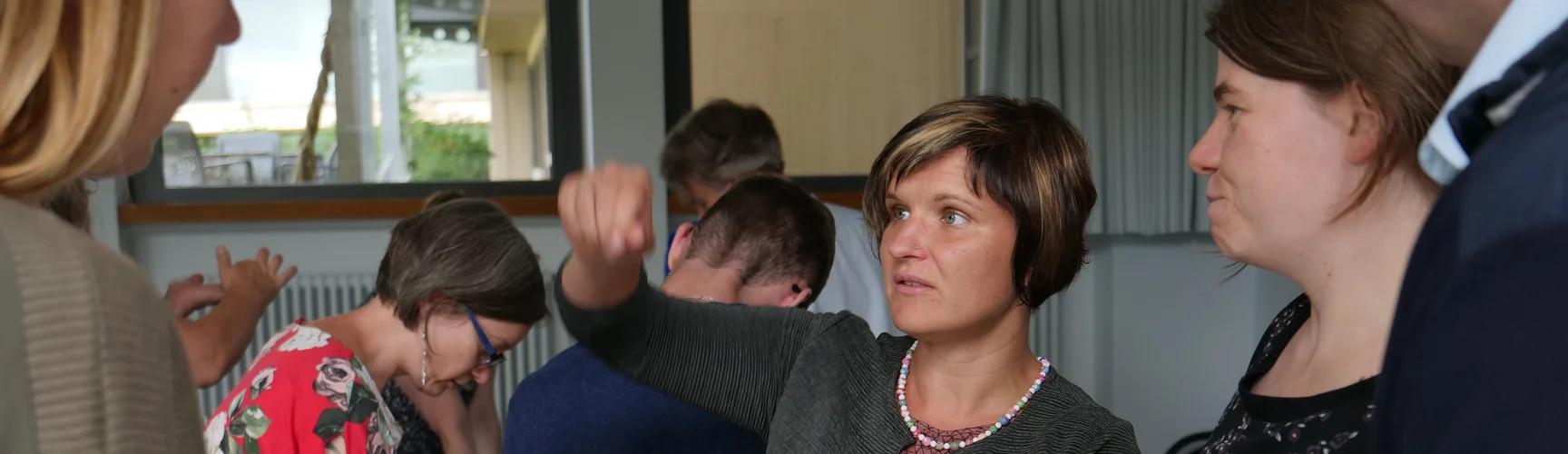
CAS Cooperative Learning and Conflict Resolution
Interaction with other people means that individuals of different ages and backgrounds come to regard learning as a valuable experience and find joy in the process of learning. Communicating with one another, working together actively and taking responsibility for the learning processes – none of this can be taken for granted, even though recent research has shown it to be extremely important for active, sustainable learning. The Continuing Professional Development programme in Cooperative Learning and Conflict Resolution (CAS) equips you to develop and successfully implement cooperative learning environments for adult education based on sound methodological principles.
Based on the latest research into the design of courses, seminars and events, this certificate programme provides practical knowledge of didactic approaches to active, self-directed and cooperative learning. The focus is on reciprocal teaching and learning (WELL) as a form of cooperative learning. This is integrated into a theoretically sound concept and explained in detail. In this way, you will be supported in developing and implementing high-quality learning environments tailored to adult education.
Conflicts can arise time and again in cooperative learning settings, as well as in teaching and learning in general. These may affect the teachers themselves, but also the group. This further education programme equips you to recognise conflicts, deal with them sensibly and appropriately, and thus resolve and manage them.
- Registration deadline
- 15 March 2027
- Duration of study
- one term
- Scope
- 15 CP
- Qualification
- Certificate of Advanced Studies (CAS)
- Start of studies
- 16 April 2027
Target audience
The CAS is aimed at individuals who are seeking a practice-oriented qualification for teaching roles in further and continuing education that meets current academic standards. They are particularly interested in learning about cooperative learning, how to implement it and how to reflect on it.
Career prospects
This further training course will enable you to enhance the professionalism of your teaching practice and make your teaching more effective.
Entry requirements
The entry requirements for the certificate programme are
- a completed university degree comprising at least 180 CP and
- at least one year’s professional experience in the field of continuing education and training or a comparable field of work.
Application
Please send your application and the required documents by email to the Centre for Academic Continuing Education.
Legal basis
Organisational consultancy
Organisation
Karlsruhe University of Education
Building
2
Room
A023
Phone
Learning outcomes and skills
During this further training course, you will gain an understanding of
- the historical development of cooperative learning and its significance within the context of adult education;
- the differences between conventional group work and cooperative learning in adult education;
- the didactic planning, implementation and reflection on cooperative learning methods;
- the evaluation of empirical studies and the application of their findings.
Upon completion of the certificate programme, you will be able to
- carry out small-scale empirical research into cooperative learning methods yourself;
- design cooperative learning settings; to apply peer teaching and learning as a form of cooperative learning;
- identify connections between group dynamic processes in cooperative learning settings;
- use specific techniques to minimise your own exposure to conflict and to analyse such conflicts;
- conduct conflict resolution discussions and analyse them.
Course structure and dates
The certificate programme runs for one semester and can be undertaken whilst working. The programme consists of three seminars, comprising a total of six days of face-to-face teaching, distance-learning elements and self-study periods, and concludes with a written examination. Upon successful completion of the programme, the Certificate of Advanced Studies (CAS) in Collaborative Learning and Conflict Resolution, worth 15 credit points (CP), is awarded.
The face-to-face sessions take place on Fridays from 9:00 am to 5:00 pm and on Saturdays from 9:00 am to 3:00 pm on the following dates:
| Module component | CP | Date |
|---|---|---|
Seminar 1: Group dynamic processes – implications for cooperative learning Group work has evolved over time and has become established in adult education in the form of cooperative learning. In order to respond effectively to group dynamic processes, interactions within the group, etc., and to apply cooperative learning appropriately, practical skills are required; these will be developed during the seminar and regularly reflected upon. | 5 | 16–17 April 2027 |
Seminar 2: Mutual Teaching and Learning – Methods and Exercises Mutual teaching and learning is a form of cooperative learning that has proven its worth in adult education. Various methods, such as group puzzles, learning duets, partner interviews, etc., will be examined theoretically, tested in practice and reflected upon at a meta-level. The aim is for participants to be able to implement these methods immediately in their own professional contexts. | 5 | 11–12 June 2027
|
Seminar 3: Resolving conflicts – dealing with myself and with others Teaching and learning situations involve interaction and are therefore inevitably subject to conflict. Conflicts can arise within oneself (‘inner team’), but also between teachers and learners and amongst learners themselves. Various approaches to resolving conflicts – such as diagnostic discussions, person-centred dialogue and conflict resolution discussions – will be presented and practised. | 5 | 2–3 July 2027 |
Programme management and content advice
Organisation
Karlsruhe University of Education
Building
2
Room
B307
Phone
Availability
By arrangement
Fees
The total fee is 1,300 euros. This includes the following services:
- Face-to-face seminars and e-learning modules,
- advice and support from the lecturers throughout all stages of the course,
- use of the university’s information and communication platform, and
- a recognised certificate (Certificate of Advanced Studies) upon successful completion of the programme.
Legal basis for fees
Leaflet
Any questions?
Our Centre for Academic Continuing Education is here to advise you on all matters relating to admission, the organisation of your studies, funding and the recognition of prior learning.

Centre of Continuing Education
Organisation
Karlsruhe University of Education
Building
2
Room
A023
Phone
Updated on 22 October 2026 by Central Web Editorial Office