


GDCh Centre for Teacher Training
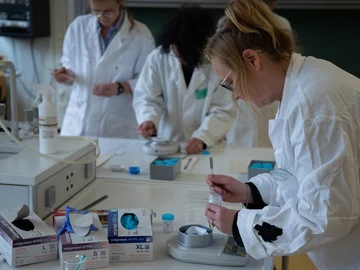
There are a total of seven GDCh teacher training centres across Germany. Our training programme includes courses in chemistry for all school levels and types, as well as general studies at primary level. A key feature of our centre is that training courses are offered not only in Karlsruhe, but also at schools and training institutions throughout the federal states of Baden-Württemberg, Rhineland-Palatinate, Hesse and the Saarland.
News
Dates
Registration
Unless otherwise stated, registration is by email to kirstin.brezesinski@ph-karlsruhe.de.
The registration deadline is approximately one week before the training date. Participation in all courses is free of charge; however, travel expenses cannot be reimbursed.
We would ask participants from Rhineland-Palatinate to obtain prior approval (“in the interests of the service”) from the Rhineland-Palatinate State Institute for Education (Ms Müller-Anstätt, 0671 9701-2127) in advance so that you are insured in accordance with the provisions of the accident insurance scheme.
Programme
| Date and venue | Event |
|---|---|
16–17 April 2026 Cancelled! Speyer State Institute of Education | iPads in Biology, Chemistry and Physics Lessons for Advanced Learners This event is aimed at advanced participants, particularly those who have already attended the lecturers’ introductory session. Register via Fortbildung-Online (RP) or by email to Wilhelm Willer. |
23 April 2026 2:30 pm – 5:00 pm PHKA | Criminal chemistry – How do experiments in digital learning environments promote cognitive activation? Selected experiments will be carried out based on the fundamentals of forensic chemistry. These will be integrated into a digital learning environment. Practical examples that stimulate cognitive engagement will be presented, carried out and reflected upon in the context of chemistry lessons. Register via LFB-Online (X55PXZ) or by email to Kirstin Brezesinski. |
| Date and venue | Event |
|---|---|
15 June 2026 1:00 pm to approx. 5:00 pm University of Ulm | School experiments with fluorescence boosters This training session will present a range of new and familiar school experiments involving fluorescence effects. Registration details will follow shortly. |
16 June 2026 09:00 to approx. 14:00 University of Ulm | School experiments with fluorescence boosters This training session will present a range of new and familiar school experiments involving fluorescence effects. Registration details will follow shortly. |
22 June 2026 Cancelled! Sindelfingen | Chemistry in a pharmaceutical context The introductory lecture and the subsequent practical session will provide a wealth of ideas (teaching concepts, experiments, models) on how this exciting and interdisciplinary topic can be implemented in a research- and development-based manner within science lessons (chemistry, biology) at upper secondary level. Register via LFB-Online (DP47XN) or by email to Kirstin Brezesinski. |
| Date and venue | Event |
|---|---|
20 July 2026 2:00 pm to 5:00 pm PHKA | TeacH2 Tomorrow – Do-it-yourself hydrogen technologies This training session will present low-cost experiments on hydrogen technologies. Among other things, participants will build an electrolysis cell from a Tic Tac tin, which can be upgraded to a fuel cell in just a few simple steps. As a special highlight, each participating teacher pair from a school will receive a kit of materials on the topic (a total of 10 kits are available). Register via LFB-Online (LL7LX8) or by email to Kirstin Brezesinski. The training session is also open to secondary school teachers. |
| Date + Venue | Event |
7 September 2026 09:30 to approx. 17:00 PL Rhineland-Palatinate | Innovative Experiments in Electrochemistry Electrical energy from the carbon sandwich – experiments on the topic of ‘lithium-ion batteries’ & Bipolar electrochemistry Target audience: Teachers of chemistry and related subjects at upper secondary level (vocational schools, grammar schools, integrated comprehensive schools) In this event, the Oetken Research Group will adapt and present current research findings in electrochemistry for use in schools. Registration via Fortbildung-Online (RP) or by email to Wilhelm Willer. |
8 September 2026 09:30 to approx. 17:00 PL Rhineland-Palatinate | Education for Sustainable Development (ESD), as a cross-curricular educational mandate spanning all school types and subjects, can be easily integrated into chemistry lessons, as many compulsory topics in both lower secondary and upper secondary education can be linked to sustainability issues. (...) Firstly, a teaching sequence on the climate impact of carbon dioxide and a student laboratory programme on ‘Ways out of the Climate Crisis’ are presented. Registration via Fortbildung-Online (RP) or by email to Wilhelm Willer. |
18 September 2026 09:00 – 12:00 PHKA | Experimenting in nursery and primary schools As part of the workshop, experiments on the topics of water and air – designed in line with the curriculum – will be presented in a child-friendly manner and tested independently by the participants. Please register by emailing Kirstin Brezesinski. FULLY BOOKED! |
23 September 2026 09:00 to 16:15 Alte Lokhalle, Mainz | Rhineland-Palatinate STEM Day 2026 for secondary school teachers As well as an inspiring talk, we’re offering exciting information forums covering practical topics. During the breaks, you can visit the exhibition to expand your network and get to know the people responsible for programmes and funding in person. All information forums are aimed at teachers working in lower secondary education. Please register by 9 September 2026. |
30 September 2026 09:30 to approx. 16:30 Justus-von-Liebig School, Waldshut-Tiengen | Creating EduEscape Games using AI and other digital tools Practical introduction to the use of escape games in chemistry lessons and creating your own escape games Register by emailing Prof. Isabel Rubner |
| Date and venue | Event |
12 October 2026 10:00 am to approx. 4:00 pm Fehling Lab, Stuttgart | TeacH2 Tomorrow – Do-it-yourself hydrogen technologies This training session will present low-cost experiments on hydrogen technologies. Among other things, participants will build an electrolysis cell from a Tic Tac tin, which can be upgraded to a fuel cell in just a few simple steps. As a special highlight, each participating teacher pair from a school will receive a kit of materials on the topic (a total of 10 kits are available). Further information about the course and how to register can be found on the Fehling-Lab website. |
| Date and venue | Event |
2 November 2026 2:00 pm to approx. 5:00 pm Seminar in Rottweil | Adhesives – an ancient art and a modern science In the introductory keynote talk, Prof. Ducci will present the teaching concept underlying the experiments selected for this training course. Afterwards, all participants will have the opportunity to try out a wide variety of experiments relating to adhesives for themselves. Target audience: Teachers of chemistry and related subjects at lower and upper secondary levels Please register by emailing Kirstin Brezesinski. |
Contact
Organisation
Karlsruhe University of Education
Building
2
Room
A200
Phone
Availability
By arrangement
Organisation
Karlsruhe University of Education
Building
2
Room
A142
Phone
Availability
By arrangement
Training on the go
A key feature of our training centre is that training courses can also be held at interested schools and training institutions in Baden-Württemberg, Rhineland-Palatinate and other federal states. The training courses are free of charge for the schools and for the participating teachers.
It is also possible to invite external speakers as guests. The costs of the training sessions can be covered, subject to agreement with us.
-
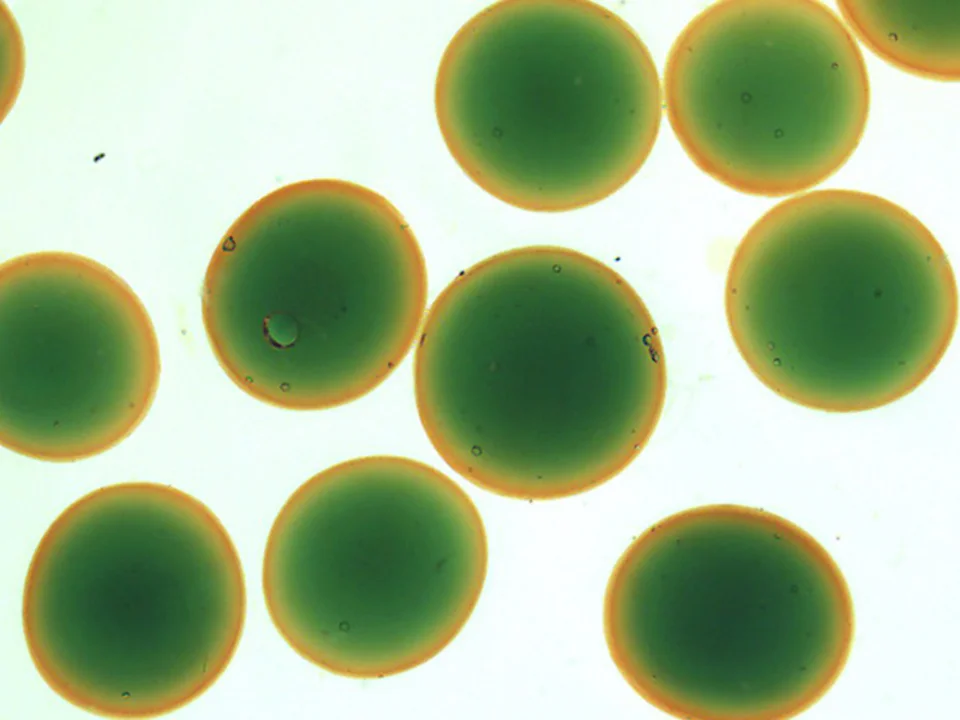
Chemical reactions taking place inside bubble tea balls
Half-day training course for teachers
-
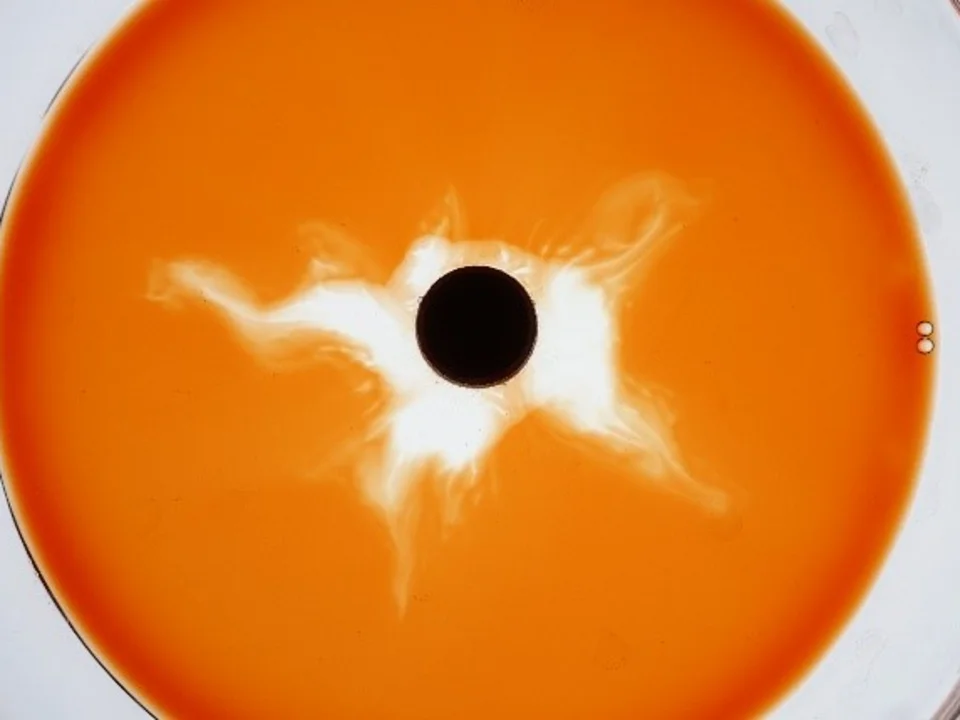
Chemistry in a pharmaceutical context
Half-day training course for teachers
-
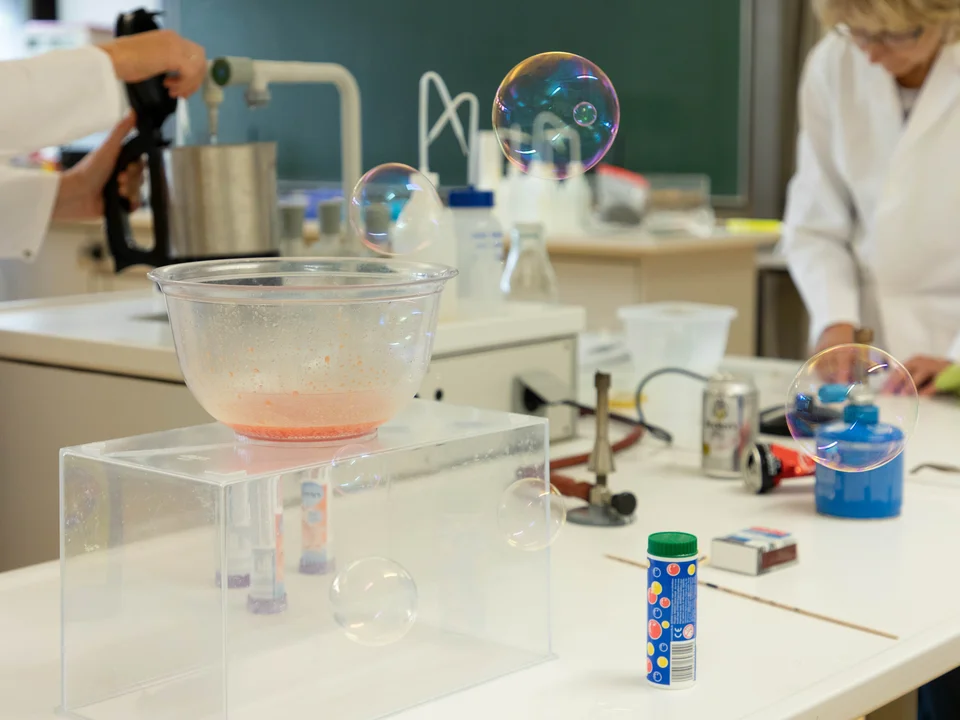
Highlights of experimental school chemistry: particle model, redox reactions, determining chemical formulae (lower secondary)
Half-day training course
-
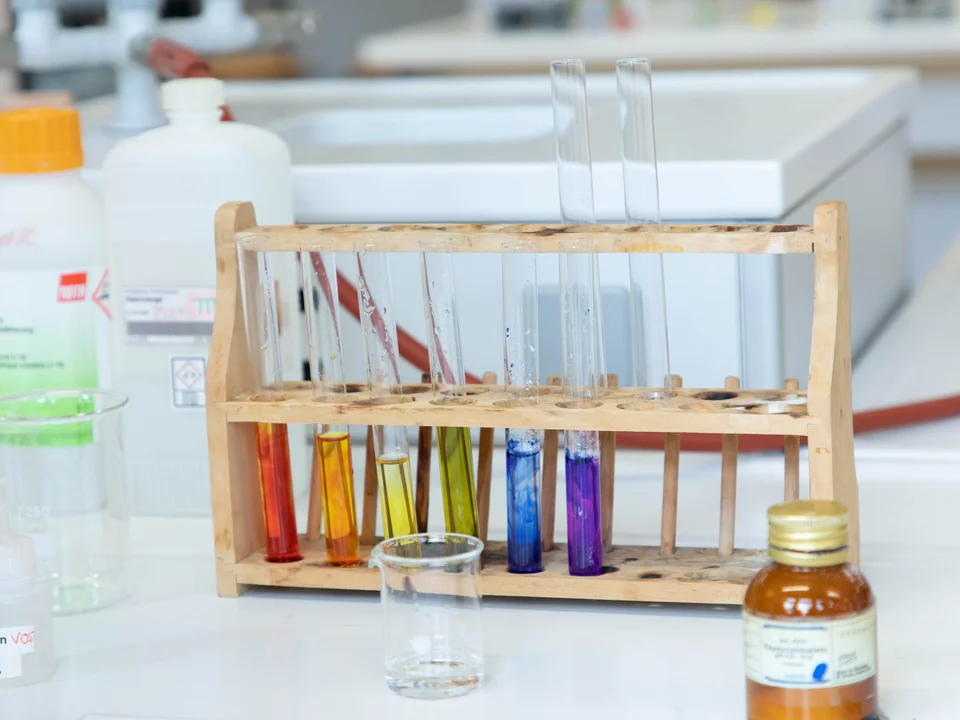
Highlights of experimental school chemistry: acids and bases
Further training
-
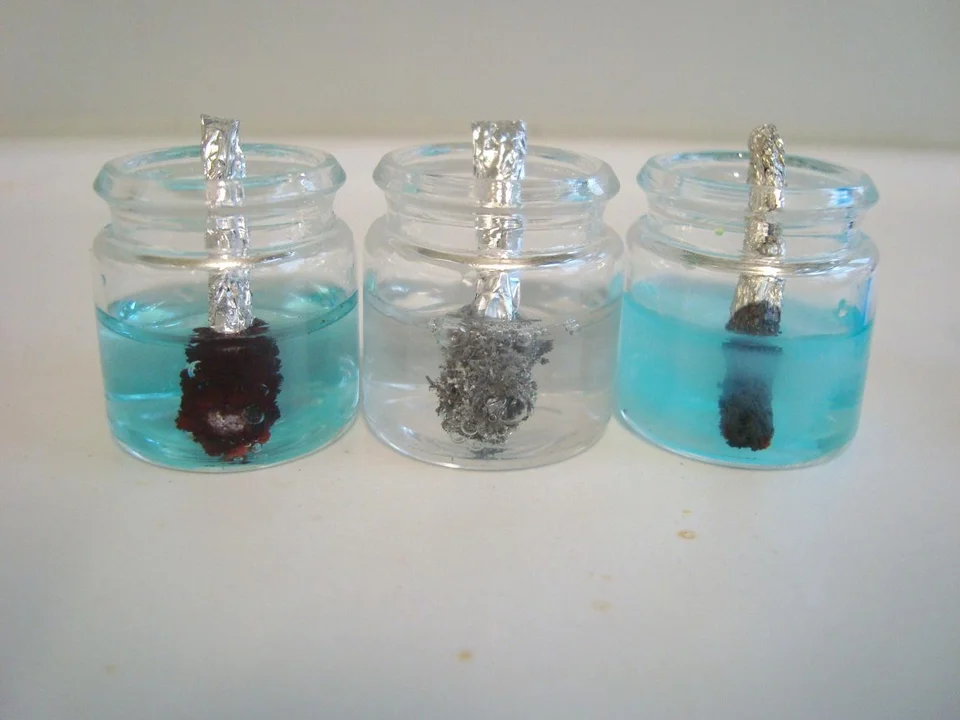
Highlights of experimental school chemistry: Electrochemical building blocks for chemistry lessons (Secondary Levels I and II)
Further training
-
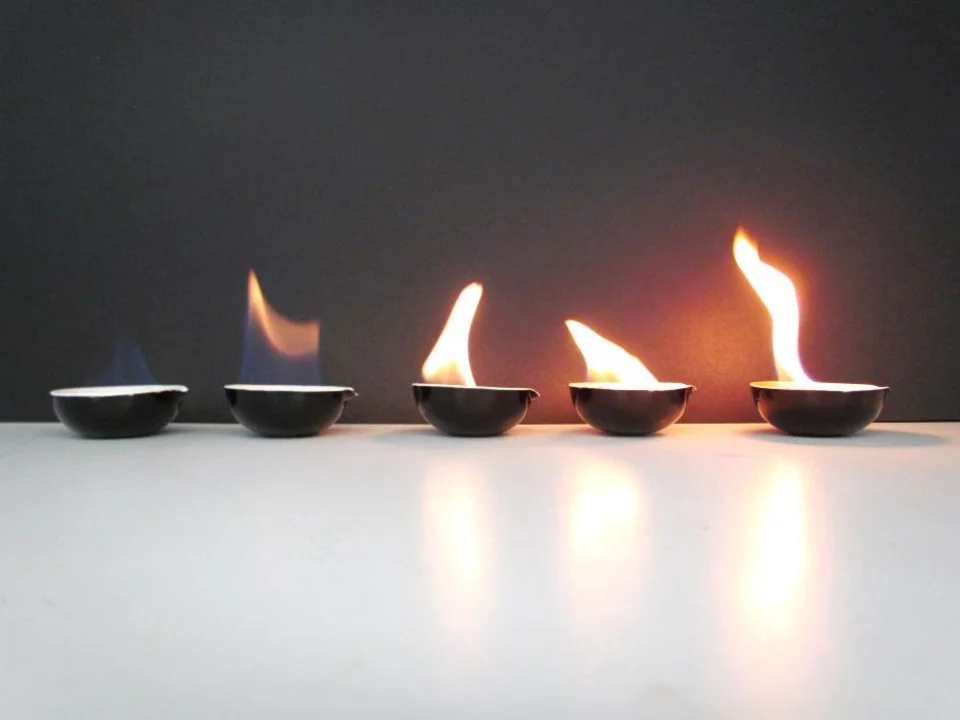
Highlights of experimental school chemistry: Organic Chemistry I
Further training
-
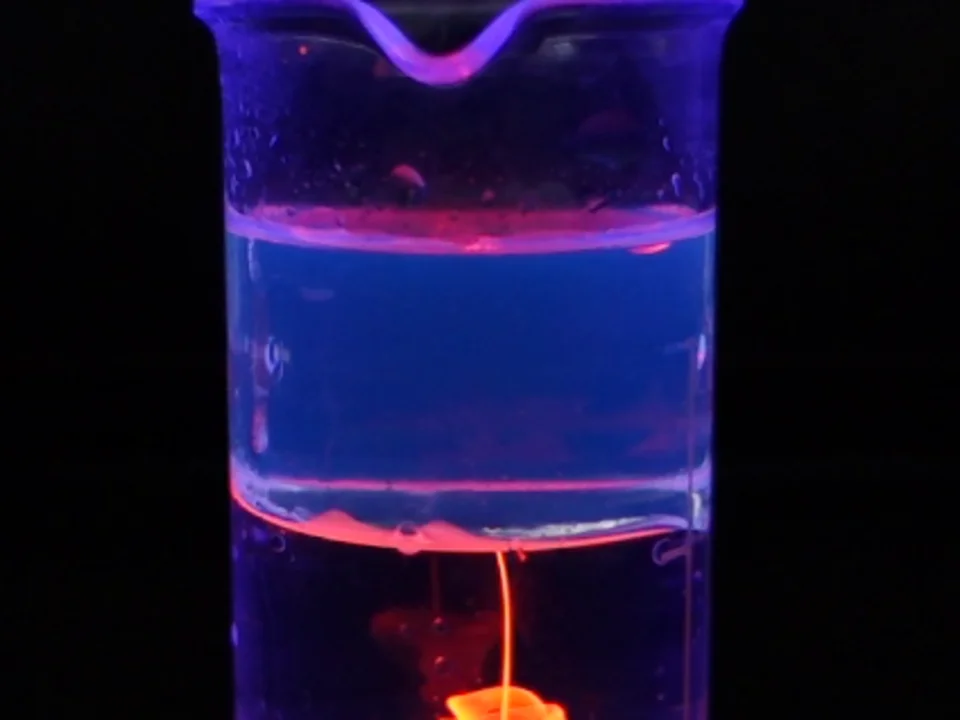
School trials with fluorescence boosters
Half-day training course for teachers
-
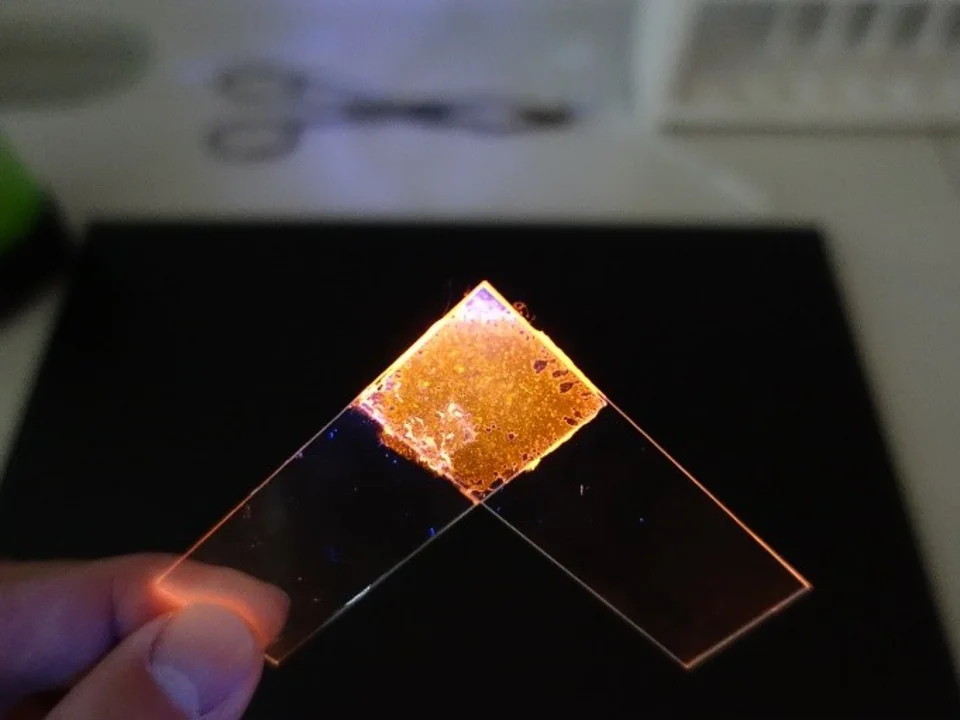
Adhesives – an ancient art and a modern science
Further training
-
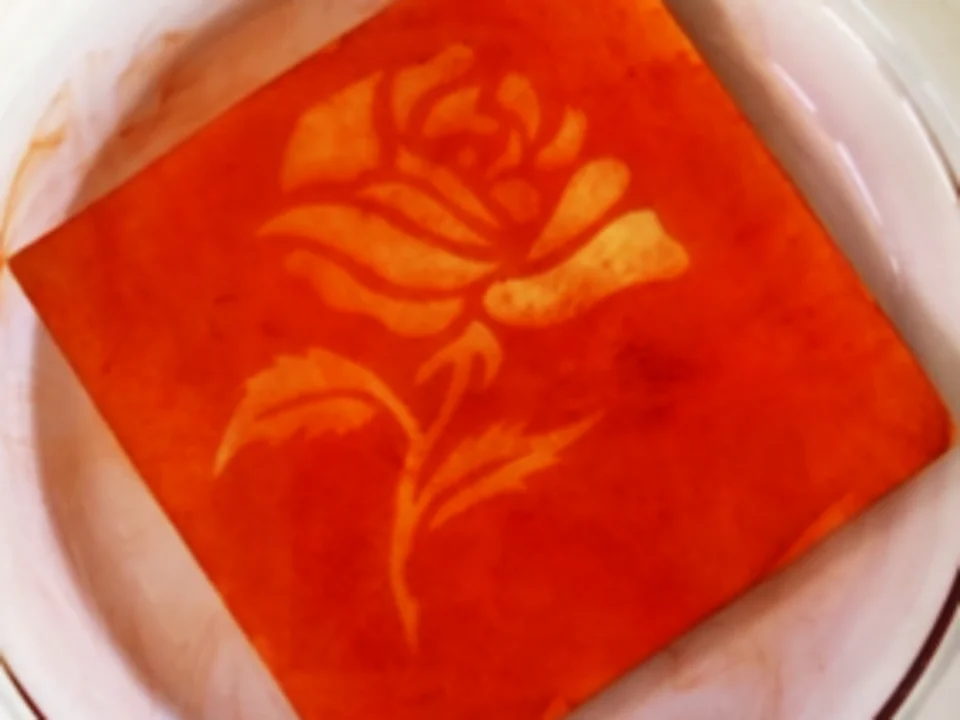
Diazotype – from azo dye to print
Further training
-
8.616:
Teachers have attended events organised by the LFZ Karlsruhe over the last 10 years
-
75:
Various schools and institutions have hosted training courses to date
A look back at our events
Chemie.BW 2023 Teachers’ Conference in Nürtingen
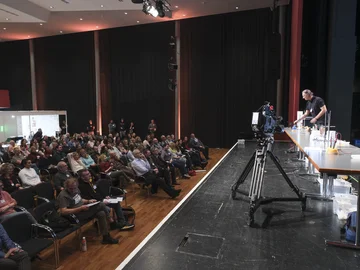
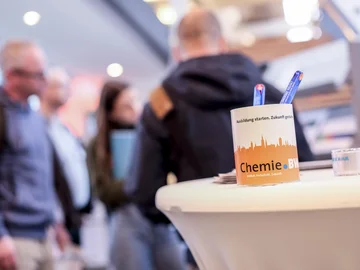
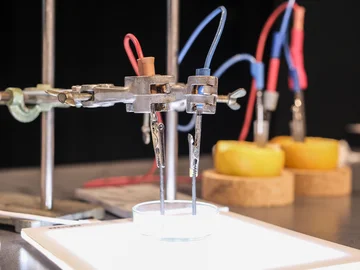
Around 240 teachers exchanged ideas at the Chemie.BW Teachers’ Conference on 15 November. Prof. Ducci delivered the engaging opening lecture, “The Orange – a Fruity Experiment Kit!”. In addition to a further talk in the afternoon, the programme featured a total of 11 different information forums and an ‘Opportunities Fair’ with numerous exhibitors. The Institute of Chemistry at the Karlsruhe University of Education was represented not only by the experimental lecture but also by an information stand on the GDCh Teacher Training Centre, where teachers were able to try out the experiments from the lecture for themselves.
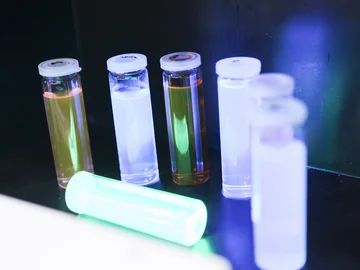
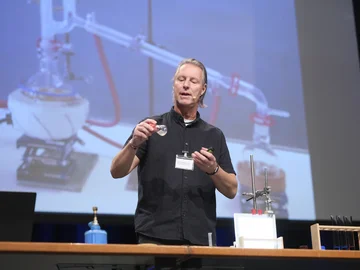
Photos: Chemie.BW / Thomas Wagner
STEM Congress 2023: How does STEM education need to change?
Südwestmetall, SCHULEWIRTSCHAFT and the ‘MINT Zukunft schaffen’ initiative organised the 2023 MINT Congress on 6 October at the Karlsruhe University of Education (PHKA). The programme featured practical workshops for primary school teachers as well as for secondary school teachers.
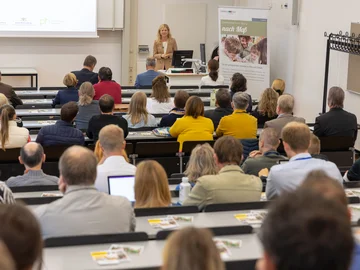
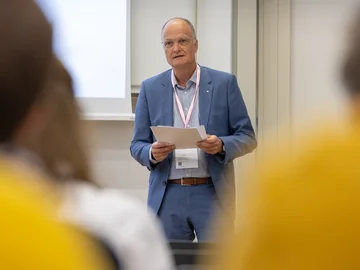
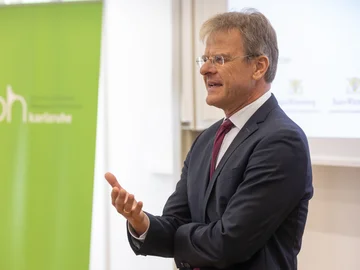
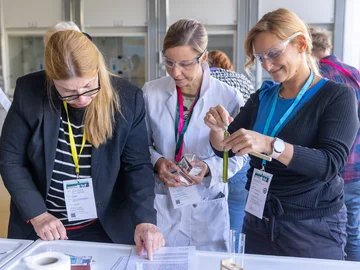
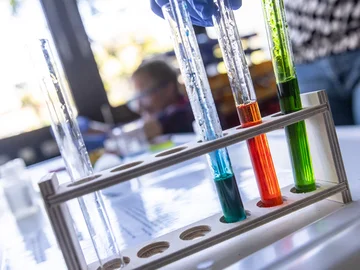
Image credits: BBQ Bildung und Berufliche Qualifizierung gGmbH
Rhineland-Palatinate STEM Days 2023
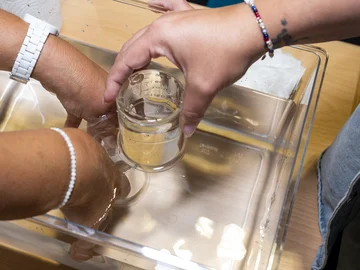
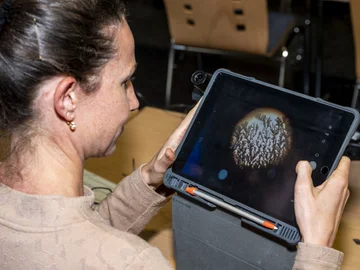
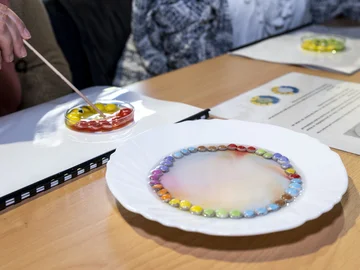
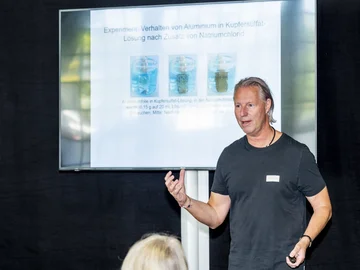
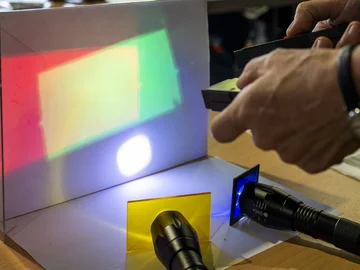
The Rhineland-Palatinate STEM Days took place on 27 and 28 September 2023 at the Alte Lokhalle in Mainz. The programme for the first day was aimed at nursery teachers and primary school teachers. Of the eight workshops held, half were organised by the Institute of Chemistry at the PHKA. Ms Niemöller and Dr Schmitz focused on the topics of ‘fire’ and ‘carbon dioxide’. Dr Brezesinski and Prof. Ducci led workshops focusing on ‘solubility’ and ‘colours’. The second day was set aside for secondary school teachers. The workshop led by Dr Brezesinski and Prof. Ducci, which was very well attended both in the morning and the afternoon, was entitled ‘Electrochemical building blocks for chemistry lessons’.
Photos: Klaus Venus
10 years of the Karlsruhe Chemistry Teachers’ Training Centre!
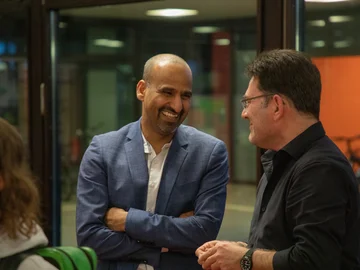
After 359 training courses involving more than 5,600 teachers and 45,387 kilometres travelled (with just one speed camera photo!) the Karlsruhe Chemistry Teachers’ Training Centre celebrated its 10th anniversary on 22 March 2023 with around 90 guests.
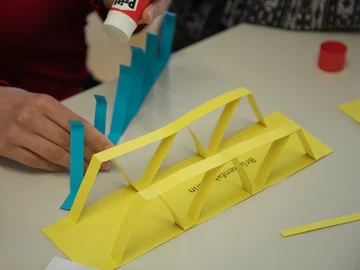
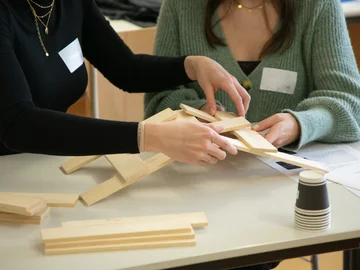
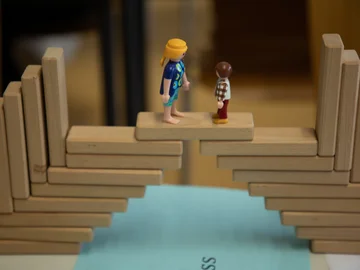
In the afternoon, three workshops began for the invited teachers: ‘Bridges – Inventing and Constructing’ (Science & Technologie e.V.), ‘Understanding Chemistry through Beautiful and Surprising Phenomena’ (Prof. Klemens Koch, PH Bern) and ‘Experiments on Modern Materials and Sustainability in Chemistry Lessons’ (Prof. Dr Stefan Schwarzer, University of Tübingen) for the invited teachers in the premises of the Institute of Chemistry.
During the subsequent speech in the lecture theatre, Prof. Stefan Schwarzer, as Chair of the GDCh Commission for Teacher Training, congratulated the Training Centre and conveyed the Commission’s and the GDCh’s congratulations. In his speech, he paid tribute, amongst other things, to the diverse programme and the dedication of the staff at the Karlsruhe site. Both, he said, had helped to create many enlightening moments for teachers both regionally and beyond over the past 10 years. Following a warm welcome from Prof. Klaus-Peter Rippe (Rector of the PHKA) and a brief speech by Dr Albert Käuflein (Mayor), Prof. Matthias Ducci (Head of the Teacher Training Centre) also said a few words. He once again thanked the GDCh, the associations of the chemical and pharmaceutical industries in Baden-Württemberg (Chemie.BW) and the PHKA for their support over the past 10 years. Prof. Amitabh Banerji from the University of Potsdam then rounded off the programme with a fascinating experimental talk entitled ‘Printed Electronics: The Hand-Printed, Flexible Zinc-Manganese Dioxide Battery – Future Technology in the Classroom’.
Everyone enjoyed a cosy end to the evening with cold drinks, finger food and lively conversation. We would like to express our sincere thanks once again to the GDCh, Chemie.BW and, in particular, Dr Tobias Pacher for their support.
Updated on 14 October 2026 by Central Web Editorial Office