


Department of German Language and Literature
At the Department of German Language and Literature, competence-based teaching and learning processes in the field of German language and literature are researched and taught. We examine the characteristics and functions of language and literature across all media and, within the German Studies programme, focus on subject-specific acquisition and teaching processes from both historical and contemporary perspectives: This involves the selection, legitimisation and justification of the subjects and objectives of language and literature teaching, the structuring of teaching and learning processes, the development and evaluation of teaching and learning materials, as well as the social and media-related conditions of teaching.
Research
The institute’s members conduct research into innovations in the field of language and literary education within a variety of research consortia, many of which operate on an interdisciplinary and cross-university basis.
Externally funded projects
-
 ResoLut project page
Erasmus+ Project ResoLut – Participating in resonance-based learning environments
When can teaching be considered successful, and what conditions must be met for it to succeed? This question lies at the heart of Hartmut Rosa’s ‘resonance pedagogy’, which views teaching as a space for relationships centred on social-emotional interaction – that is, the reciprocal relationship between pupils, teachers and educational content – rather than merely on cognitively measurable skills. Rosa uses this term to describe the shared, productive ‘resonance’ around a so-called ‘slice of the world’. This could be, for example, a shared interest or a subject being taught, but also art or political events. Through processes of negotiation within and between individuals, teaching becomes value-oriented learning.
To date, the approach developed by the renowned sociologist has not yet been tested in practice. The three-year project on resonance-oriented teaching and learning, funded by the EU’s Erasmus+ programme, aims to change this. The project partners are the Karlsruhe University of Education (PHKA, Germany; project lead), the State Academy of Applied Sciences in Nysa (PANS, Poland), the Carinthia University of Education (PHK, Austria) and Ludwig Maximilian University of Munich (LMU, Germany).
-
 LemaS project page
Achievement Sets a Standard (LemaS)
During the first phase of the LemaS project (2018–2023), the Karlsruhe University of Education, in collaboration with teachers from partner schools across Germany, developed adaptive approaches to diversity-sensitive learning and teaching materials in the areas of creative writing (Sub-project 15 led by PD Dr Beate Laudenberg) and linguistic and rhetorical communication (Sub-project 17 led by Prof. Dr Carmen Spiegel), which were then implemented, evaluated and revised in schools. These concepts and materials (P3roducts) support teachers in identifying linguistic talents and providing targeted support to all pupils – regardless of their background, gender or social status – in a way that is tailored to their potential and needs.
As one of three research teams within the LemaS Transfer Content Cluster on Languages (IC 4), based at the universities of Frankfurt (Mayer research team – literary discussion and reading), Karlsruhe (Laudenberg research team – literary writing and rhetorical communication) and Potsdam (Freitag-Hild research team – complex tasks in English lessons), the Laudenberg / Winterscheid team monitors and researches the transfer and transformation process of the P3 products developed during the first phase of LemaS as they are implemented by teachers at the partner schools. -
 Fan fiction in the classroom
Fan culture and education
The project (2024/25), funded by the PwC Foundation, aims to adapt the literary practices of digital reading and writing communities within fan fiction culture for use in classroom teaching and learning processes. The project is being carried out in cooperation with the LPZ at the Literaturhaus Stuttgart, the University of Bremen and the LIS Bremen.
(Prof. Dr Ina Brendel-Kepser, since 2024)
PhD projects
The aim of this doctoral research project is to develop support measures for digital writing and to evaluate their effectiveness. Based on the empirical findings of a diagnostic preliminary study, an interactive learning pathway designed to promote digital text production skills in the broadest sense (keyboard typing, word processing functions, digital text production strategies) will be devised and compared with a ten-finger typing course. To evaluate effectiveness, a pre-post-test design will be used to assess learners’ typing behaviour and to examine the effect on text quality and revisions to texts they have written themselves in response to a specific writing task.
(Kathrin Heller, since March 2023)
The study examines the impact of different writing interventions on the narrative text production skills of pupils in the orientation stage. The focus is on three groups: an intervention group working with digital storytelling (DST), a second intervention group using a text-analytical approach, and a control group receiving no specific support. The aim of the study is to determine whether digital storytelling, as a multimedia narrative form, leads to a lasting improvement in narrative text competence. To this end, the participants first write down their ‘tall tale’ before receiving targeted support as part of their respective interventions. They then revise their text and produce a final version, thereby making any improvements in competence visible.
Data collection takes place at nine secondary schools in Karlsruhe involving around 200 pupils, who are taught in 1:1 iPad teaching and learning settings and compose their texts digitally. In addition to findings on the impact of digital and multimodal writing methods, the study also provides new insights into the use of iPads in German lessons. The analysis of the texts is based on the RANT scale (Wild, 2020) as well as a holistic assessment using the NAEP scale. In addition, confounding and control variables such as reading comprehension, motivation to write, socio-economic status, keyboard writing proficiency, literacy experience and media socialisation are recorded in order to account for external influencing factors and to gain nuanced insights into the effectiveness of the writing interventions.
(Maximilian Stoller, since August 2023; sub-project within the AQUA-d Research and Early-Career Academy)
The study examines how generative AI, acting as a conversational partner, can promote written argumentation and reflective thinking amongst young people in lower secondary education. It analyses which pedagogical concepts and prompts are best suited to using AI in a way that supports critical thinking and the ability to structure information logically. This is tested, by way of example, using the topic of ‘fast fashion’ to encourage a conscious engagement with socially relevant issues.
(Gloria Goller, since October 2023; sub-project within the Knowledge Media Collaborative Doctoral Programme)
In primary school German lessons, digital spelling aids can be used primarily during the writing process, specifically when revising the formal structure of a text. It is important that pupils interact with the digital spelling aids – in other words, that they learn to question orthographic structures and suggested corrections, and to check whether these make sense in the context of their own text. A prerequisite for the sustainable use of digital spelling aids in German lessons is a didactic implementation based on evidence-based findings.
(Tina Neff, 10/2020–01/2026)
Research Colloquium
The Institute regularly organises a research colloquium. This series of events offers both early-career academics and established researchers a platform to present and discuss their current projects in the field of language and literary education.
Anyone interested is warmly invited to attend the colloquium and to contribute actively to the discussions.
Teaching
Note for students
On the student information platform for the Institute of German Language and Literature in the InnovationSpace, you will find all the key documents and information relating to studying German, as well as the latest updates.
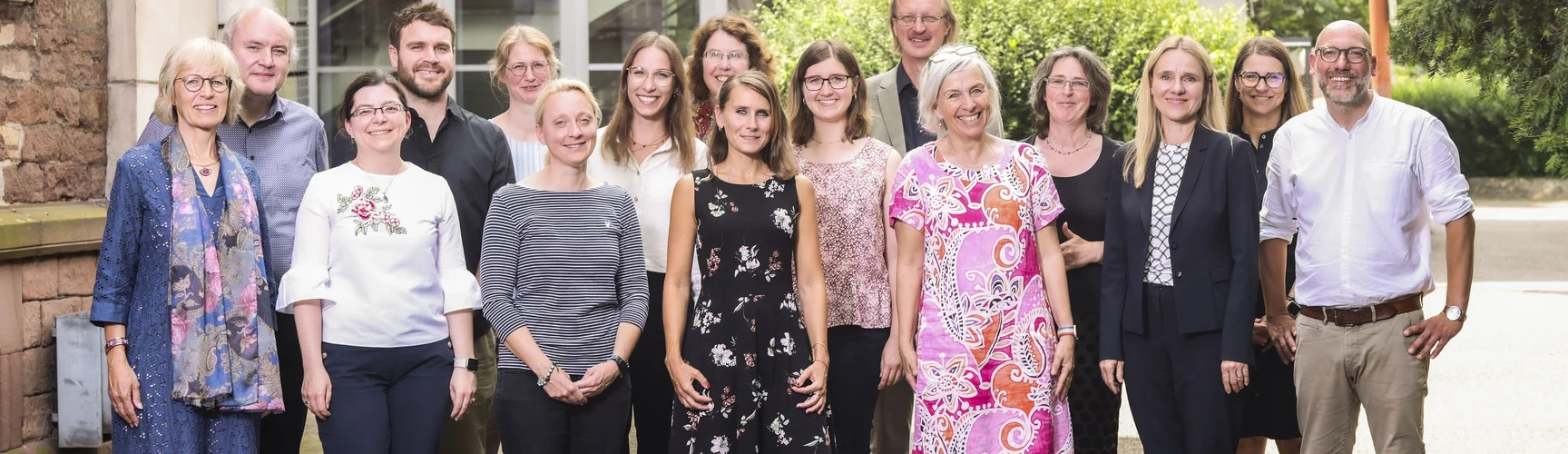
Institute team
Organisation
Karlsruhe University of Education
Building
3
Room
206
Phone
Availability
Wednesdays, 9.45–10.45 am (room 3.206 or online) – Please register via my profile on Stud.IP.
By arrangement
Organisation
Karlsruhe University of Education
Building
3
Room
208
Phone
Availability
By arrangement
Literary Studies and Teaching Methods
Organisation
Karlsruhe University of Education
Building
3
Room
203
Phone
Availability
By arrangement
Organisation
Karlsruhe University of Education
Building
3
Room
202
Phone
Availability
Office hours in the 2026 summer semester: Thursdays, 4.30–5.30 pm (please register by email)
Organisation
Karlsruhe University of Education
Building
3
Room
205
Phone
Availability
Appointment registration via Stud.IP
Organisation
Karlsruhe University of Education
Building
3
Room
206
Phone
Availability
Office hours:
During the 2025/26 winter semester, every Friday from 12:00 to 13:00 (please book via email).
Other times may be possible – please send me a message if you are planning to attend the office hours or would like to suggest an alternative time.
Organisation
Karlsruhe University of Education
Building
3
Room
202
Phone
Availability
Consultation hours
Tuesday: 9.00 am – 11.00 am (please book by email)
Organisation
Karlsruhe University of Education
Building
3
Room
122
Phone
Availability
By arrangement
Organisation
Karlsruhe University of Education
Building
3
Room
207
Phone
Availability
By arrangement
Organisation
Karlsruhe University of Education
Building
3
Room
204
Phone
Availability
By arrangement
Organisation
Karlsruhe University of Education
Building
3
Room
102
Phone
Availability
By arrangement
Organisation
Karlsruhe University of Education
Building
3
Room
207
Phone
Availability
Office hours during the lecture term: Tuesdays, 11:00 am-12:00 noon (in person or online; book via stud.ip) and by arrangement
Organisation
Karlsruhe University of Education
Building
3
Room
112
Phone
Availability
By arrangement
Linguistics and Language Teaching
Organisation
Karlsruhe University of Education
Building
3
Room
209
Phone
Availability
By arrangement
Organisation
Karlsruhe University of Education
Building
3
Room
204
Phone
Availability
By arrangement; see also the booking system in StudIP
Organisation
Karlsruhe University of Education
Building
3
Room
203
Phone
Availability
Consultation hours in my StudIP profile
Organisation
Karlsruhe University of Education
Building
3
Room
205
Availability
By arrangement
Organisation
Karlsruhe University of Education
Building
3
Room
208
Phone
Availability
By arrangement
Organisation
Karlsruhe University of Education
Building
3
Room
206
Phone
Availability
Wednesdays, 9.45–10.45 am (room 3.206 or online) – Please register via my profile on Stud.IP.
By arrangement
Organisation
Karlsruhe University of Education
Building
3
Room
102
Phone
Availability
See Stud.IP
Organisation
Karlsruhe University of Education
Building
3
Room
208
Phone
Availability
By arrangement
Organisation
Karlsruhe University of Education
Building
3
Room
102
Phone
Availability
By arrangement
Organisation
Karlsruhe University of Education
Building
3
Room
205
Phone
Availability
Thursdays between 10.00 and 11.00 am, and by arrangement
Lecturers
Organisation
Karlsruhe University of Education
Building
3
Room
208
Phone
Availability
By arrangement
Organisation
Karlsruhe University of Education
Availability
By arrangement
Organisation
Karlsruhe University of Education
Availability
By arrangement
Organisation
Karlsruhe University of Education
Building
3
Room
105
Phone
Availability
Mondays to Wednesdays (and by appointment)
Organisation
Karlsruhe University of Education
Availability
By arrangement
Organisation
Karlsruhe University of Education
Availability
By arrangement
Former
Organisation
Karlsruhe University of Education
Availability
By arrangement
Organisation
Karlsruhe University of Education
Availability
By arrangement
Speech training
Speaking is a process that involves the whole body. To experience this more consciously and learn how to apply it, practical exercises form the main component of the ‘Fundamentals of Speaking’ course. That is why we actively focus on, for example, posture and body language, breathing, vocal technique, articulation, intonation, audience engagement, etc.
In addition to developing the fundamentals of speaking, each course has a specific focus. You can choose between:
- Body, Breathing, Voice
- Oral rhetoric
- Storytelling and reading aloud in primary school
You are welcome to enrol in these modules from the very first semester.
Organisation
Karlsruhe University of Education
Building
3
Room
5
Phone
Availability
Office hours: Tuesdays and Thursdays, 9.30–10.00 am and 11.30 am–12.00 noon.
Please drop by for signatures; for a meeting, please email to arrange an appointment.
Organisation
Karlsruhe University of Education
Building
3
Room
5
Phone
Availability
By arrangement
Organisation
Karlsruhe University of Education
Building
3
Room
5
Phone
Availability
Mondays, 9.30–10.00 am and 3.30–4.00 pm
Updated on 23 October 2026 by Hannah Lutz