


Department of Arts
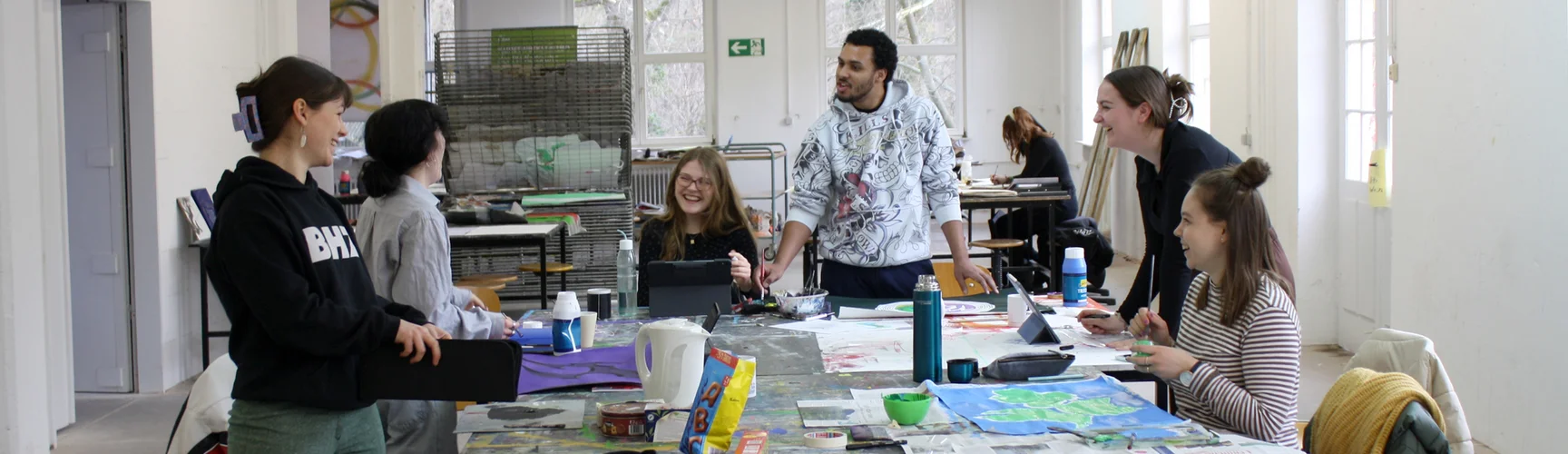
The Art module within a teacher training programme is aimed at those who wish to enable children and young people to have aesthetic experiences through art lessons in primary or lower secondary schools.
The Master’s programme in Cultural Education (KULT) is aimed at students who wish to initiate and carry out educational projects in non-school cultural institutions, such as theatres, museums, cultural authorities or cultural associations in the independent arts scene.
News
Dates
Institute team
Organisation
Karlsruhe University of Education
Building
3
Room
315
Phone
Availability
By arrangement
Organisation
Karlsruhe University of Education
Building
3
Room
321
Phone
Availability
By arrangement
Organisation
Karlsruhe University of Education
Building
3
Room
318
Phone
Availability
By arrangement
Organisation
Karlsruhe University of Education
Building
3
Room
318
Phone
Availability
Office hours during the lecture term: Thursdays 12.00 noon –1.00 pm and by arrangement
Organisation
Karlsruhe University of Education
Building
3
Room
318
Phone
Availability
By arrangement
Organisation
Karlsruhe University of Education
Building
3
Room
321
Phone
Availability
By arrangement
Organisation
Karlsruhe University of Education
Building
3
Room
106
Phone
Availability
Mon, Tue, Thu: 8.00 am to 12.00 noon
Teleworking: Wed, Fri: 8.00 am to 12.00 noon
Lecturers
Organisation
Karlsruhe University of Education
Availability
By arrangement
Organisation
Karlsruhe University of Education
Availability
By arrangement
Organisation
Karlsruhe University of Education
Availability
By arrangement
Organisation
Karlsruhe University of Education
Availability
By arrangement
Organisation
Karlsruhe University of Education
Availability
By arrangement
Organisation
Karlsruhe University of Education
Availability
By arrangement
Organisation
Karlsruhe University of Education
Availability
By arrangement
Research
Our institute offers a range of opportunities for research-oriented study. As a student, you will be introduced to the methodology of art education research and supported in developing your own small-scale research projects. Seminars in
- subject didactics and subject-specific scholarship,
- personal artistic practice,
- art workshops for children and young people, and
- teaching placements
. Artistic research, research into art education and subject-specific scholarship, as well as research into teaching, instruction and learning, are reflected in artistic practice, Bachelor’s and Master’s theses, and doctoral dissertations.
Research projects
Artificial Intelligence for Arts Education (AI4ArtsEd)
What opportunities do diversity-sensitive approaches to artificial intelligence offer in cultural education? The Karlsruhe site is addressing this question from an arts education perspective and, in collaboration with the University of Cologne, forms one of three sub-projects. The focus is on designing AI technology for use in arts and cultural education, as well as developing critical and reflective teaching modules.
COMeARTS
The Karlsruhe site is trialling collaborative workshops for teachers, art educators, multipliers, researchers and students on the theme of ‘Machine Learning and learning about machines – artistic strategies and algorithmic literacy in the culture of digitality’. In cooperation with the University of Cologne, concepts and materials are also being developed on the themes of the post-digital condition, visuality in the post-internet era, creating, publishing and queering arts education. This sub-project forms part of the BMBF-funded ComeArts programme “training through networking – networking through training” within the Kompetenzverbundlernen:digital consortium.
about Art and Research (aAaR)
The interview series ‘about Art and Research’ (aAaR) explores perspectives on artistic research and offers brief and concise insights into discourses, practices and methods. In the interviews, researchers and artists discuss traditions, attitudes and approaches to artistic research in response to eight questions. The questions are intended to be adapted individually by the interviewees. about Art and Research (aAaR) was designed for use in research and teaching and is intended to be a growing collection of materials.
Care Research Lab
The Care Research Lab is a research project led by Martina Leeker (University of Cologne) and Konstanze Schütze (Karlsruhe University of Education) which explores theoretical and practical perspectives on the field of care (German: Für/Sorge) and, together with invited experts, explores these areas along the dimensions of ‘Thinking about Care’, ‘Performing Care’ and ‘Prototyping Care’.
The project website is currently under construction.
Organisation
Karlsruhe University of Education
Building
3
Room
321
Phone
Availability
By arrangement
Algorithmic Literacy Lab* (ALL*)
The Algorithmic Literacy Lab* is dedicated to developing discussion and working materials that enable participants to experience and discuss algorithmic systems and their implications in an educational context in a meaningful way. To this end, ten experts in algorithmic decision-making systems, anti-racist work, political education, feminist policy-making, media studies, utopian theatre and machine learning have come together. The result is a set of ready-to-use teaching and learning modules, available on the participatory platform MYOW – Workbook Arts Education.
Situation Between
‘Situation Between’ is a collection of research-based perspectives on the theory and practice of art education and art outreach. The platform maps out research practices, explores forms of knowledge and opens up a new field of discourse for artistic education. ‘situierung zwischen’ was launched in 2023 as a collaboration between Silke Ballath, Annika Niemann and Konstanze Schütze and sees itself as a growing platform.
Organisation
Karlsruhe University of Education
Building
3
Room
321
Phone
Availability
By arrangement
KuLO – Art and Cultural Institutions as Learning Organisations
Our university, Heidelberg University of Education and its Academy for Academic Continuing Education have jointly developed the continuing education programme ‘KuLO – Arts and Cultural Institutions as Learning Organisations’. By the end of 2022, a hybrid, work-integrated continuing professional development programme had been established, in which 78 staff members from arts and cultural institutions took part. The programme focused on opening up these institutions both internally and externally to promote greater diversity and participation, as well as on the areas of audience development, accessibility, digitalisation and sustainability. Following the successful completion of the pilot phase in 2022, which involved around 80 participants from across Baden-Württemberg, the KuLO team developed an e-learning programme. The educational content is available free of charge throughout the German-speaking world.
Organisation
Karlsruhe University of Education
Building
3
Room
318
Phone
Availability
Office hours during the lecture term: Thursdays 12.00 noon –1.00 pm and by arrangement
You might also find this interesting
Updated on 23 October 2026 by Lutz Schäfer