


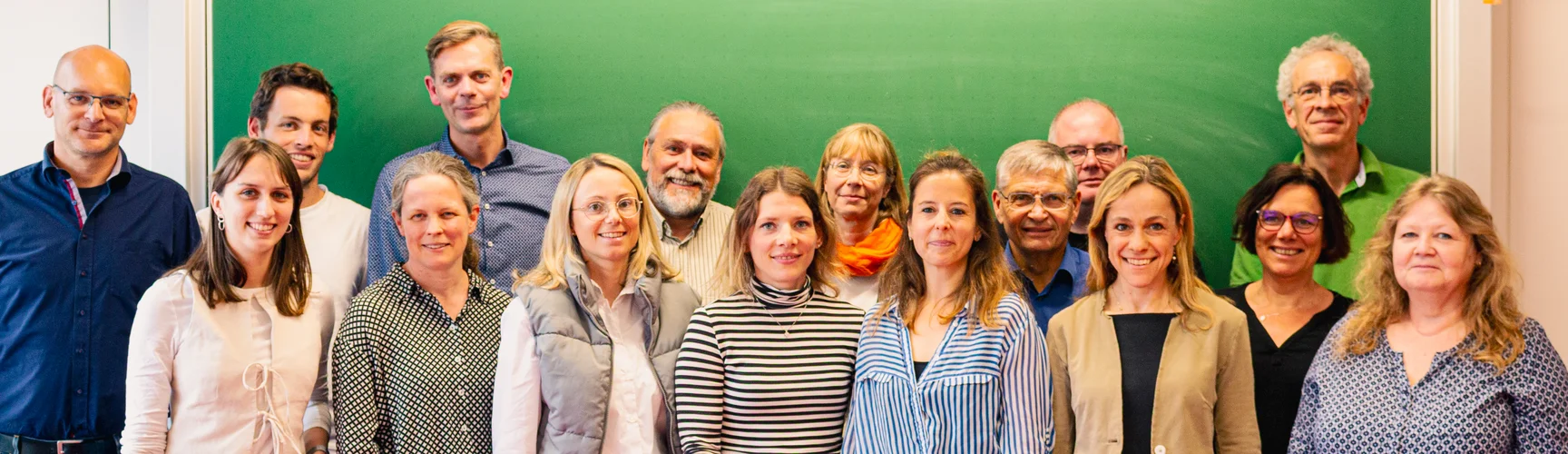
Department of Mathematics
We investigate successful and challenging mathematical learning processes at pre-school, primary and secondary levels, as well as the professional development of teachers who support children in these areas. A particular focus is on concepts of numbers and operations, and the role of strategies and structural perception, which we examine using qualitative and quantitative methods. Our work in mathematics education combines subject-specific analysis with a clear focus on typical learning difficulties and how to overcome them on an empirical basis. The training programme is designed to be practice-oriented and, through collaborations with MiniMa and the Counselling Centre for Maths Difficulties, enables a close integration of theory and teaching practice. The aim is to deliver mathematics teaching focused on understanding, based on scientifically sound and practical skills.
News
Research and Projects
In the field of primary education, we are researching successful and unsuccessful learning processes relating to content-based and process-oriented competences among learners in the early years and primary school. Another key area of research focuses on the investigation of teachers’ competences and their development when working with children on mathematics in the pre-primary and primary sectors.
Particular emphasis is placed on researching concepts of numbers and operations, as well as the role played by strategies and processes of structural perception in this context. In this context, both qualitative methods (clinical interviews, analysis of interactions, eye-tracking) and quantitative methods are employed to optimise or evaluate diagnostic tools and support approaches.
- L2
- KiA
- ILeA plus
- Maths Difficulties Advice Centre
- QUASUM – Assessment of teachers’ subject-specific teaching skills
- MiniMa – Young children and adults discover maths together with the ‘Machmit’ workshop – a project on early mathematical education
- MULDI – Multiplication and Division Investigations Project – collaboration with Monash University (Australia)
- Sustainability Laboratory
- Mathestark
- InDiKo
- InDiKo-X
- MalAR – Learning Maths with Augmented Reality
- MINT2KA – Collaborative project on teaching and learning laboratories – Collaboration with KIT
- ETraM – Eye-tracking in mathematics education
MISS – Talking to children about structures – collaboration with the University of Bielefeld
- Benz, C. & Tiedemann, K. (2021). Talking to children about structures. In A.-K. Harr & B. Geist (Eds.), Language Support in Nurseries. DTP Volume 12, (pp. 409–425.) Hohengehren.
- Benz, C., Reuter, F. & Zöllner, J. (2021): Discovering mathematics. On the role of processes and structures in early mathematical education. Early Childhood 4/21
- Borys, T., Hartmann, M. (2022). The ‘Fermi Graph’ – An illustrative reconstruction of the solution processes for Fermi problems. In: Mathe vernetzt, Vol. 5. Münster: MUED
- Borys, T. (2021). Service and Research-Based Learning in Higher Education – Extended Mathematical Learning Opportunities for a Science Festival. In: Proceedings of the 2021 International Joint Conference on Information, Media and Engineering (IJCIME), IEEE; pp. 248–251
- Gasteiger, H., Bruns, J., Benz, C., Brunner, E. & Sprenger, P. (2020). Mathematical pedagogical content knowledge of early childhood teachers – A standardised situation-related measurement approach, *ZDM Mathematics Education*, ZDM (52), 193–205
- Harlander, J. and Rosebrock, S., Relative vertex asphericity, Canadian Math. Bull. 64 (2) (2021); pp. 292–305.
- Hartmann, M., Borys, T., Kawasaki, T. and Okamoto, H. (2019). Observing characteristics in solving Fermi tasks by modelling and creating activity diagrams. In: Proceedings of the 2019 International Joint Conference on Information, Media and Engineering (IJCIME), IEEE; pp. 97–100
- Padberg, F., & Wartha, S. (in press). The Didactics of Fractions (6th edition). Heidelberg: Springer Spektrum.
- Reit, X.-R. (2021). CamCarpets as a cross-year-group and cross-subject modelling project. In: Bracke, M., Ludwig, M., Vorhölter, K. (eds.) New Materials for Reality-Based Mathematics Teaching 8. Real-world connections in mathematics teaching. Springer Spektrum, Wiesbaden. https://doi.org/10.1007/978-3-658-33012-5_8
- Reit, X.-R., & Schäfer, M. (2020). An analysis of learners’ solution strategies in the context of modelling tasks. Journal on Mathematics Education, 11(3), 501–512. https://doi.org/10.22342/jme.11.3.11345.501-512
- Reit, X.-R. (in press). Enriching the learning of analytic geometry through augmented reality – development of an AR smartphone app. Proceedings of the Twelfth Congress of the European Society for Research in Mathematics Education (Feb 2022). Bolzano, Italy: Free University of Bozen-Bolzano
- Rosebrock, S., Visual Group Theory — A Computer-Oriented Geometric Introduction, 3rd edition, Springer Spektrum (2020); 252 pages.
- Rosebrock, S., ‘Even Numbers’, in: Festschrift for F. Heinrich, to be published by WTM, (2022).
- Schulz, A., & Wartha, S. (2021). Numbers and Operations at the Transition from Primary to Secondary School. Heidelberg: Springer Spektrum.
- Sprenger, M. (2022). Effects of professional development on the topic of dyscalculia on subject-specific teaching skills and motivational orientations: Professionalisation of mathematics teachers. Springer Fachmedien Wiesbaden. https://doi.org/10.1007/978-3-658-36799-2
- Sprenger, M., Wartha, S. & Lipowsky, F. (2019). Effects of training programmes on dyscalculia on teachers’ diagnostic knowledge – Assessing practical knowledge through video vignettes. In: Leuders, T., Christophel, E., Hemmer, M., Korneck, F. & P. Labudde (eds.), Subject-Specific Didactic Research in Teacher Education, Münster: Waxmann Verlag.
- Sprenger, P. (2021). Processes involved in the structured perception of sets and structure-based number determination in pre-school children – An eye-tracking study. Wiesbaden: Springer Spektrum. https://doi.org/10.1007/978-3-658-33102-3
- Sprenger, P. & Benz, C. (2020). Children’s perception of structures when determining cardinality of sets – results of an eye-tracking study with 5-year-old children. ZDM, 51 (1), 187. https://doi.org/10.1007/s11858-020-01137-x
- Sprenger, P. & Benz, C. (2020). Perceiving and using structures when determining the cardinality of sets – A child’s learning story. In M. Carlsen, I. Erfjord & P. S. Hundeland (Eds.), Mathematics education in the early years. Results from the POEM4 Conference, 2018 (213–227). New York: Springer.
- Stellfeldt, Christian (2022): How does GPS work? – GPS and DGS in the classroom. In: Mathematics in Context. Ideas and resources for interdisciplinary maths teaching. Volume 7. Münster.
- Stellfeldt, Christian (2022): A corpse (in the cellar) – Forensic medicine and mathematics. In: Mathematics in Context. Ideas and resources for interdisciplinary mathematics teaching. Volume 7. Münster.
- Wartha, S., & Benz, Ch. (2020). Errors as arithmetic learning obstacles and opportunities. Learning and Learning Disorders. 1–15. https://doi.org/10.1024/2235-0977/a000323
Study and Teaching
In mathematics education, on the one hand, an analysis is carried out ‘from the perspective of mathematics’ to determine how the subject matter can be presented in such a way as to facilitate optimal learning. On the other hand, consideration is given ‘from the learner’s perspective’ to the difficulties that are likely to arise, and how these can be identified and overcome. This is based on empirical findings from research.
When mathematics is taught in an educational setting (school, nursery, etc.), the integration of subject-specific knowledge and subject-specific teaching skills is essential. The focus of training in mathematics education is highly practice-oriented. In addition to teaching placements in the subject, students can work directly with children as part of seminars at the MINIMA centre and the Dyscalculia Counselling Centre. Supervision facilitates a close link between theory and practice during the initial phase of training. The aim of the mathematics-related degree programmes is to build practical teaching skills grounded in real-world application, based on a scientific and theoretical foundation.
Members of the Institute of Mathematics attach great importance to understanding-oriented mathematics teaching during school placements. In this context, a number of guiding principles have been formulated.
-
Guiding Principles of the ISP
- File type/size
- .pdf / 0 B
- Language
- German
Institute Management
Organisation
Karlsruhe University of Education
Building
2
Room
A227
Phone
Availability
By arrangement
Secretariat
Organisation
Karlsruhe University of Education
Building
2
Room
B242
Phone
Availability
By arrangement
Institute team
Organisation
Karlsruhe University of Education
Building
2
Room
B200
Phone
Availability
By arrangement
Organisation
Karlsruhe University of Education
Building
2
Room
A242
Phone
Availability
By arrangement
Organisation
Karlsruhe University of Education
Building
2
Room
A245
Phone
Availability
By arrangement
Organisation
Karlsruhe University of Education
Building
2
Room
B242
Phone
Availability
By arrangement
Organisation
Karlsruhe University of Education
Building
2
Room
A244
Phone
Availability
By arrangement
Organisation
Karlsruhe University of Education
Building
2
Room
A143
Phone
Availability
By arrangement
Organisation
Karlsruhe University of Education
Building
2
Room
A143
Phone
Availability
By arrangement
Organisation
Karlsruhe University of Education
Building
2
Room
A243
Phone
Availability
Tuesdays, 4–5 pm (by appointment via email)
Organisation
Karlsruhe University of Education
Building
2
Room
B214
Phone
Availability
By arrangement
Organisation
Karlsruhe University of Education
Building
2
Room
A241
Phone
Availability
By arrangement
Organisation
Karlsruhe University of Education
Building
2
Room
B140
Phone
Availability
By arrangement
Organisation
Karlsruhe University of Education
Building
2
Room
A245
Phone
Availability
Office hours during the 2026 summer semester (lecture period):
Please arrange an appointment by email.
Available times are Wednesday at 1.40 pm and Friday at 2.30 pm.
Office hours during the break following the 2025/26 winter semester:
Please register for the appointments in March and April by email two days in advance.
Wed, 04 Feb 2026 at 11:00 am
Wed, 18 Mar 2026 at 11:00 am
Fri, 10 Apr 2026 at 11:00 am
Organisation
Karlsruhe University of Education
Building
2
Room
B140
Phone
Availability
Office hours for the 2026 summer semester:
Tuesdays 9.00–10.00 am, by prior arrangement via email.
Organisation
Karlsruhe University of Education
Building
2
Room
A242
Phone
Availability
Consultation hours by appointment via email:
Monday: 1.45 pm – 2.30 pm in room 2.A242
Organisation
Karlsruhe University of Education
Building
2
Room
A143
Phone
Availability
By arrangement
Organisation
Karlsruhe University of Education
Building
2
Room
A227
Phone
Availability
By arrangement
Organisation
Karlsruhe University of Education
Building
2
Room
A245
Phone
Availability
Mondays and Thursdays by arrangement
Organisation
Karlsruhe University of Education
Building
2
Room
A244
Phone
Availability
By arrangement





Updated on 23 October 2026 by Central Web Editorial Office