
Hello, I'm Lidiia from the International Office. I’ll guide you through everything you need to do so we can welcome you to our university.
With your consent, we store data on your device to analyze your usage behavior and seamlessly integrate external content for you. You can revoke your consent or make specific settings at any time.


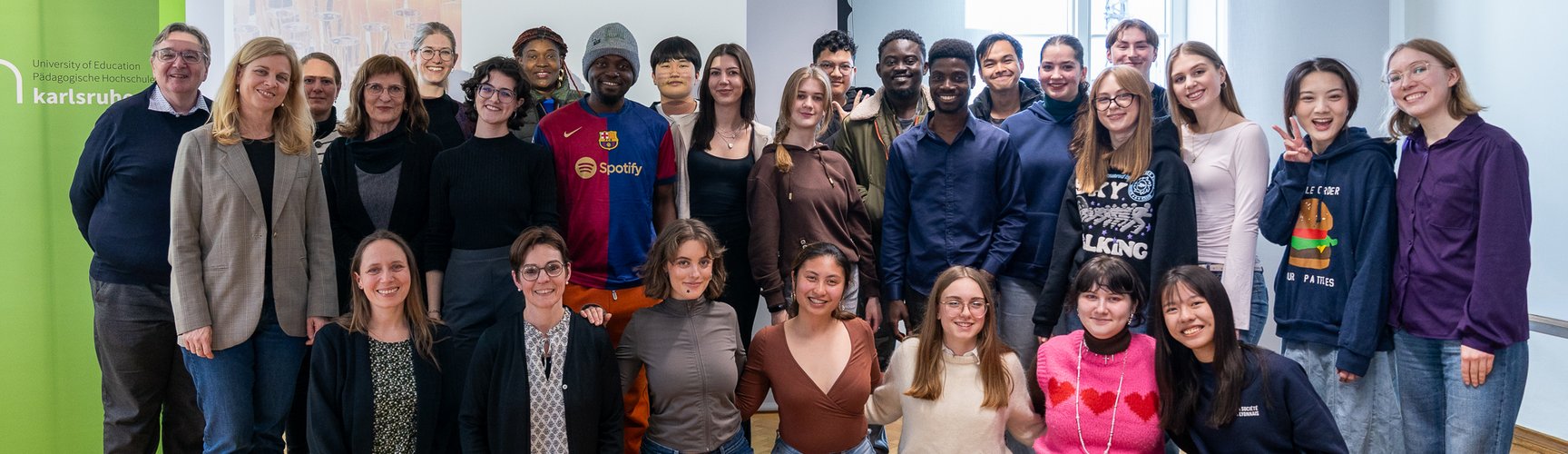
Are you interested in spending a semester or even a full year abroad as an international exchange student? We look forward to welcoming you at the Karlsruhe University of Education! On this page, you will find all the information you need for planning your stay abroad.
Hello, I'm Lidiia from the International Office. I’ll guide you through everything you need to do so we can welcome you to our university.
Organisation
Karlsruhe University of Education
Building
3
Room
117, 116
There are many interesting courses to choose from as part of our semester programme. To help you quickly feel at home in Karlsruhe and at our university, we offer individual support and organise an exciting social programme during the orientation period.
But first of all, you will meet your personal buddy.
Even before you arrive in Karlsruhe, we will put you in touch with your personal “buddy”. This is a fellow student who has offered to support you during your first few days at our university. When you arrive in Karlsruhe, they will pick you up from the train or bus station, take you to your accommodation, and assist you with enrolment and any administrative issues during the following days. Quite often, buddies become friends.
The range of courses varies from semester to semester. For information on current courses, please visit our online course catalogue on the LSF platform. Although the platform is set up in German, you can filter for courses that are taught in English or French. Here you can see how to use this search function:
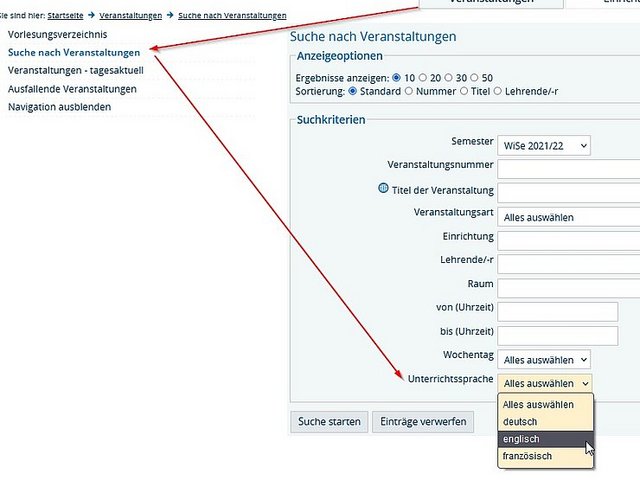
If you are planning your stay abroad for the winter semester, take a look at the courses offered in the previous winter semester; for the summer semester, refer to the courses offered in the previous summer semester. This will give you an idea of the types of courses usually available at our university.
Regardless of your field of study, you may choose courses from all subjects, provided that your home institution agrees. You may also attend most practical modules in Arts, Music, or Sports - just let us know in good time before the semester begins.
In addition, you have the opportunity to complete a supervised internship at a school in or around Karlsruhe during the semester. The internship takes place one morning per week. As the number of internship placements is limited, please let us know as early as possible if you are interested in this opportunity.
Incoming exchange students can choose to stay for one semester or for a full academic year at the University of Education Karlsruhe. One academic year consists of two semesters: the winter and the summer semester. The table below provides the key dates for each semester. Please pay special attention to our orientation programme, which includes not only a free German language course but also a variety of activities.

In order to receive our application package, you must be nominated by your home institution. Please make sure to apply to one of the exchange programmes offered at your home institution in due time.
| Winter semester | Summer semester | |
| Nomination | by 15 May | by 15 November |
| Application | by 31 May | by 30 November |
| Letter of admission | mid-June | mid-December |
| Orientation period/intensive German language course | from the beginning of September to mid-October | from the beginning of March to the beginning of April |
| Lecture period | from mid-October to the beginning of February | from the beginning of April to the end of July |
| Examination period | until mid-February | until mid-August |
Please be aware that the working language for most courses is German, with the exception of courses taught at the Institute of Multilingualism (English and French Studies), which are taught in English and French respectively.
Practice teaching at a German School
Upon request, we can offer our international exchange students the opportunity to visit and/or teach lessons at German primary or secondary schools (in German or English). The teaching practice is supervised by a mentor, and credits are awarded upon successful completion of the internship.
In general, visiting students from most non-EU countries must apply for a visa before entering Germany. Please contact the German embassy or consulate in your home country for guidance.
Visiting students from the USA, Canada, Australia, New Zealand, Israel, Japan and South Korea can enter Germany without a visa. They will receive a residence permit in Karlsruhe for the duration of their stay abroad.
Once you arrive in Karlsruhe, flexible office hours, a well-organised buddy programme, intensive German language courses, and a variety of leisure activities (including day trips and evening events) will help ensure the best possible start to your semester abroad at our university.
We are usually able to provide most of our international exchange students with accommodation in the residence halls near the university campus. Students have their own dormitory rooms but typically share a bathroom and kitchen.
If you would like to arrange accommodation independently, we recommend the following website:
Before you leave, your home institution will usually ask you to sign a learning agreement. However, it may be easier to select your courses and modules once you have arrived at our university, provided that your home institution can wait until then. The typical workload per semester is 30 ECTS credits. Please check with your home institution to find out how many ECTS credits you are required to earn during your stay abroad.
Generally, it is not necessary to register for courses or modules before you arrive in Karlsruhe.
| German grade | Meaning |
|---|---|
| 1.00 - 1.49 | Very good (best grade that can be achieved) |
| 1.50 - 2.49 | Good |
| 2.50 - 3.49 | Satisfactory |
| 3.50 - 4.00 | Sufficient (minimum score to pass the exam) |
| 4.01 - 6.00 | Fail |
| passed | all required coursework and examinations have been completed, grading is not provided |
Bringing Europe to the classroom
"Europa macht Schule" (EmS) is a programme designed to promote the encounter and exchange between young Europeans, which is carried out on a voluntary basis. The aim is to bring the idea of Europe-wide exchange to life and to encourage social engagement and foster political participation. This way, all participants can experience the cultural diversity of Europe hands-on and in a vivid manner.
The programme is funded by the German Academic Exchange Service (DAAD) and the voluntary association "Erasmus macht Schule e. V.".
Visiting students from all over Europe are invited to take part in a project with a German school class, where they can present their home country in a creative way: For example, by playing Gaelic football with the students, simulating the French presidential elections or letting the children experience a typical Turkish school day. Depending on their age, the participating pupils will be actively involved in organising, realising, and documenting the project. The programme will conclude with a closing ceremony, at which all the projects of the respective city will be presented to the public. This way, the pupils will get to know another European country hands-on and in a vivid manner, while the students from abroad can immerse themselves in part of German life and culture beyond the university. They are in contact with locals and feel like welcome guests.
The intercultural exchange within the EmS projects is intended to actively promote international understanding throughout Europe. Thanks to the participation of visiting students from all over Europe, all participants get to know the differences and similarities of the neighbouring European countries. This way, theoretical knowledge about cultures becomes hands-on experience and relevant in practice, while cultural bias is reduced. By presenting the special features and characteristics of their home countries in a creative way at schools all over Germany, students become kind of ambassadors for their home countries. This is how Europe's cultural diversity comes alive!
Updated on 14 April 2026 by Central Web Editorial Office